
How many open volunteer slots are on your schedule for next week?
If the answer is “more than I want to admit,” you are not alone. Most coordinators we speak with are working harder at recruitment than they were three years ago and seeing thinner returns across nearly every channel. The recurring social post that used to fill a Saturday shift now generates two replies. The volunteer fair produces a stack of email addresses and only a few completed registrations. The board member who used to bring four friends a year is now pulled into competing priorities at work.
This is not a motivation problem. People still want to volunteer. The 2024 release from AmeriCorps and the U.S. Census Bureau reports that 28.3% of Americans—about 75.7 million people—participated in formal volunteering between September 2022 and September 2023. The willingness is there. What has changed is where prospective volunteers spend their time, what they expect from a sign-up experience, and how much friction they will accept before stepping away.
This post walks through 20 volunteer recruitment strategies that work in that environment, and that can be supported by a modern volunteer management system like VolunteerHub. Before we get into tactics, we will start with a brief diagnostic on what weak recruitment is actually costing your program. Then we will move into five themed groups of strategies, organized so you can read straight through or jump directly to the cluster that best matches where your program is today.
What inconsistent recruitment is really costing your volunteer program
The visible cost of unfilled shifts is the unfilled shift. The full impact reaches several layers deeper.
When shifts stay open, the work rarely disappears. It shifts to the coordinator. Coordinators respond by working longer hours, relying on the same dependable core of volunteers until those individuals quietly burn out or take on the tasks themselves. Extra hours turn into coordinator turnover. In many of the programs we work with, coordinator turnover is a 12-to-18-month setback, and the institutional knowledge that leaves with that person is rarely documented in a way the next coordinator can easily use.
Over time, your program’s capacity is capped by what one tired coordinator can hold in their head. New initiatives do not launch. Existing programs do not scale. Mission delivery falls short of what the budget was designed to support. On a board report, this rarely appears as a “recruitment problem.” It appears as flat or declining outcomes against rising costs.
Three diagnostic questions to ask before you choose tactics:
- How many open volunteer slots are on your schedule for the next four weeks, and how many of those are recurring rather than event-driven?
- How long does it take a brand-new volunteer to get from "interested" to their first completed shift, and what percentage of recruits drop out somewhere in that gap?
- Of the volunteers who completed a first shift in the last quarter, what percentage came back for a second?
- Where are the gaps in your current volunteer base, by role, day of week, and skill?
- What does a "best-fit" volunteer look like for each gap, in terms of availability, motivation, and skill?
- Which channels are you already using, and which of them produced an actual completed first shift in the last 90 days?
- What is your real recruitment budget, including coordinator time, ad spend, swag, and printed materials?
- What does the path from "first interest" to "first shift" look like today, and where in that path are people falling off?
- Can prospective volunteers find an open role, register, and get on the schedule in under five minutes from a phone, without a coordinator's intervention?
- Can a coordinator see, in one view, where each recruit is in the pipeline from interest to first shift to second shift?
- Are recruitment, communication, scheduling, and tracking running off the same source of truth, or living in three or four disconnected systems that the coordinator reconciles by hand?
- Can the coordinator segment former volunteers, donors, and prospective recruits to send the right message to the right list without rebuilding the segment every time?
- Does the system run automatically when the coordinator is on vacation, in training, or out sick?
If those three numbers are uncomfortable to write down, recruitment is not the only issue. Recruitment is feeding a leaky bucket. Most of what follows works whether your bucket is leaky or not, but the strongest move is usually to fix the bucket and the inflow at the same time.
Before you launch a volunteer recruitment push
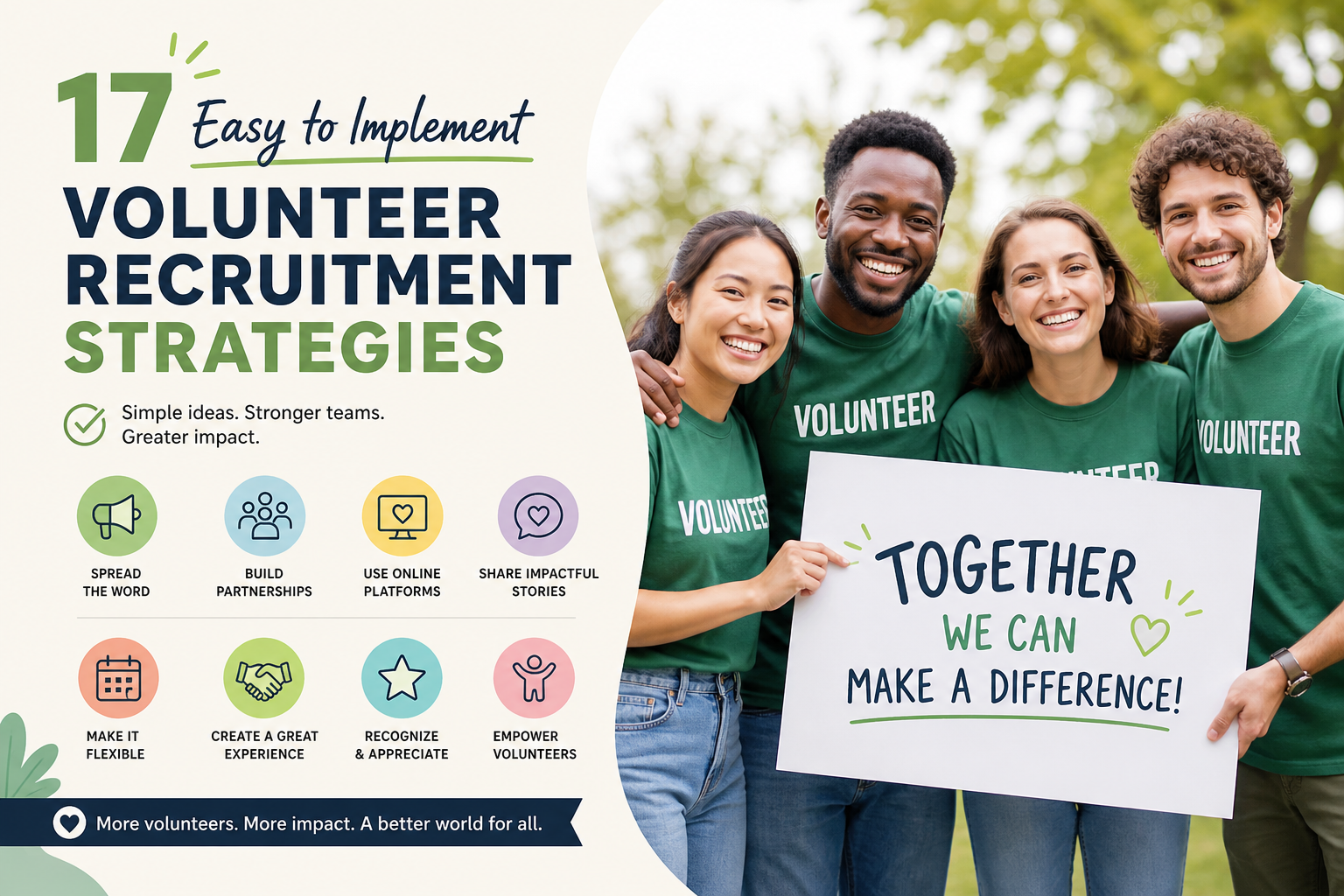
A clear plan is more powerful than a long list of tactics. Before you apply any of the strategies below, take time to work through these five planning questions with your team so everyone is aligned on priorities and resources.
Also, it helps to be honest about what “recruitment” means in practice. Recruitment that generates sign-ups but does not lead to first shifts is not recruitment. It is data entry. The tactics that follow assume you have a functional pipeline from first contact to first completed shift. If that pipeline is not yet in place, focus on the “make it easy to say yes” cluster first so every new prospect can move smoothly from interest to action.
Activate the people who already know you
Your highest-converting recruitment channel is almost always someone who has already volunteered, given, or stood next to your work. These tactics tend to be free or close to it, and they are the fastest path to a completed first shift.
1. Mobilize current volunteers as recruiters
Tell every active volunteer that recruitment is on. Make it easy for them to invite a friend. A short, copy-pasteable message they can send by text or DM beats a polished social post that most of them will not share. Build an ambassador track for the volunteers who are clearly drawn to it: a one-page pitch they can hand out, a personal referral code, recognition when their referrals complete a first shift.
2. Reconnect with former volunteers
Former volunteers are the most underused recruitment list at most nonprofits. Pull a list of everyone who logged at least one shift in the last 24 months and is no longer active. Segment by why they left (life event, schedule change, disengagement, no exit data). Send a different message to each segment. People who left because their kid started high school will respond to a different note than people who quietly disengaged.
3. Engage your board with a specific ask
"Help us recruit volunteers" is too vague to act on. "Would each board member be willing to make three personal asks this quarter, with a list of the roles we most need filled?" is something a board member can actually do. Tie the ask to specific gaps in your program and follow up.
4. Recruit from your donor list
Volunteers and donors overlap more than most programs assume. People who give already believe in the mission. Many of them have time they would happily contribute if you asked specifically. Coordinate with your development team, so the ask does not collide with a current giving campaign, and make sure the volunteer-to-donor and donor-to-volunteer paths are both visible in your data.
Show up where prospective volunteers already are
The goal in this section is simple: be easy to find and easy to say “yes” to when someone with a few free hours and an interest in your mission goes looking for a way to help.
Optimize your volunteer landing page
Most prospective volunteers will visit your website before they ever speak with a member of your team. That means your volunteer landing page does the heavy lifting for recruitment.
- Within the first scroll, the page should clearly answer five questions:
- What does volunteering with you actually involve?
- Who is it for?
- What is the time commitment?
- What is the next step to get started?
- How long will registration take?
Because so many supporters now discover you on mobile, page load time and a mobile-friendly registration experience matter more than ever. Field reports indicate that the majority of first-time visits to volunteer pages now come from a phone, so designing this page with mobile users in mind is essential.
Use short-form video on the platforms Gen Z and younger Millennials use
Public 2026 trend reporting from Red Cross and Points of Light has volunteer participation skewing younger online, and short-form video is the format that consistently produces interest from those groups. Instagram Reels and TikTok work when you show real volunteers doing real work in 30 to 60 seconds, with a clear ask at the end. Polished promotional clips do not. Coordinator phone footage of a Saturday shift, with permission, generally outperforms anything produced by an outside agency.
Use LinkedIn for skill-based and corporate volunteering
LinkedIn is an effective channel for the volunteers most nonprofits underuse: working professionals who are willing to contribute a specialized skill (such as legal, marketing, finance, IT, or writing) to a defined project.
Present the opportunity as a concise, specific role description rather than a generic “volunteers needed” graphic. Skill-based listings perform best when they read like a real position, with clear responsibilities, outcomes, and time expectations that help professionals see exactly how they can make a meaningful contribution.
Run targeted online ads, including Google Ad Grants
Eligible nonprofits can apply for up to $10,000 per month in Google Ad credits through the Google Ad Grants program. To turn those credits into actual volunteers, focus your ads on specific roles and times rather than broad messages.
Ads framed around a clear need—such as “Evening shift greeter near downtown, Thursdays 5–8 PM”—consistently outperform generic calls like “Volunteer with us.” A pay-per-click model helps keep spending focused on interested prospects, and the more precise you are about the role, location, and time commitment, the higher your conversion from click to completed first shift.
Send a recurring email recruitment to your list
Email continues to drive meaningful volunteer sign-ups, particularly when each message is built around one clear role and includes the time commitment, location, and a direct registration link.
Make the subject line about the opportunity itself rather than your organization. For example, “Saturday morning food sorting volunteer needed near 30303” will outperform “Volunteer with us this spring” because it tells readers exactly what you need and when.
Industry surveys often report nonprofit email return on investment in the range of $36 to $40 for every dollar spent. Your actual results will depend on list quality, message relevance, and how consistently you connect each email to a specific, actionable volunteer role.
List with volunteer matching sites
Volunteer matching sites are still a meaningful low-cost channel, particularly for first-time volunteers searching by city or interest. Audit your listings on Idealist, Engage by Points of Light, JustServe, Catchafire (for skilled / pro-bono), United Way, and DoSomething (for younger volunteers) at the start of every quarter. Outdated listings are worse than no listing.
Pitch a local news story tied to a real moment
Local TV, radio, neighborhood newsletters, and community Substacks all remain meaningful recruitment channels for region-specific programs. Pitch a story tied to something concrete: a milestone, a measurable outcome, a volunteer with a specific story. "We need volunteers" is not a story. "Atlanta family food pantry serves its 100,000th meal this Saturday and is short ten volunteers" is a story.
Build channel partnerships that recruit at scale
Individual recruits churn. Channel partners do not. The work is heavier up front and produces compounding returns.
Partner with employers running volunteer time off (VTO) programs and ERGs
Most mid-size and large U.S. employers now offer paid volunteer time off, and Employee Resource Groups (ERGs) at those employers actively look for recurring, mission-aligned volunteer opportunities. ERGs are particularly valuable because they are pre-organized groups with internal coordinators who can drive turnout for you. Build a short list of the 10 to 20 employers within your service area, identify which of them have ERGs aligned with your cause, and approach the ERG leads directly rather than the corporate giving team.
Recruit through values-aligned community organizations
Faith communities, civic groups, neighborhood associations, music ensembles, scouting organizations, and book clubs are all recurring sources of volunteers who already organize collectively. Pitch them shifts they can take as a group. Group volunteering tends to convert at a higher rate to repeat participation than individual recruiting because the social glue is already there.
Build a pipeline through schools and universities
Students from middle school through graduate programs make up a meaningful share of new-to-volunteering populations. The right entry point is usually the service-learning office, civic engagement office, or a specific program coordinator inside an academic department. Be honest about the role: students show up for things that count toward graduation requirements, build a real resume line, or come with a friend group attached.
Network with local government and elected officials' offices
Local government staff sit on a deep network of community-engagement resources, civic-group contacts, and corporate sponsors. They are usually willing to make introductions when the ask aligns with their constituents' interests. The point of contact is often a community engagement liaison or constituent services lead, not the elected official.
Make it easy for volunteers to say yes
Most recruitment loss happens between "interested" and "first shift completed." The friction in that gap is where pipelines die.
Write role descriptions that read like real roles
Vague role descriptions ("help out at our events") attract everyone and convert no one. Specific role descriptions ("Saturday morning greeter, 8 to 11 AM, two-hour orientation, comfortable greeting families in Spanish a plus") attract a smaller pool that converts at a much higher rate.
Make registration mobile-first and short
Public trend reporting indicates roughly 73% of Gen Z and Millennial volunteers expect a seamless sign-up process and will abandon a multi-page form. Limit first-touch registration to the minimum fields you actually need. Collect everything else after the first shift, when commitment is real.
Use AI to do the first-pass writing work, not the relationship work
AI is now genuinely useful for the parts of recruitment that take coordinator time without requiring coordinator judgment: drafting role descriptions, generating subject-line variants, personalizing follow-up emails to recruits at scale, and summarizing inbound interest forms. Treat it as a productivity multiplier on the writing layer. The relationship layer (the first call, the orientation, the first shift) still needs a human.
Prioritize accessibility from the start
Accessibility opens recruitment to people who would otherwise self-screen out. Offer virtual and hybrid roles where the work allows, micro-volunteering for one-time tasks, flexible scheduling for shift workers, wheelchair-accessible sites with clear signage, and clear language about what physical or sensory demands a role involves. Public reporting indicates virtual volunteers actually contribute more hours per year (around 95) than in-person-only volunteers (around 64) once they are engaged, so virtual is not a downgrade.
Host monthly info sessions, in person and virtual
A 30-minute info session, run on a recurring schedule, gives prospective volunteers a low-commitment first step that converts much higher than "fill out the form." Cover what your program does, the open roles, the registration and screening process, the training process, and time for questions. Make it easy to register for a shift at the end of the session while interest is highest.
What "good" volunteer recruitment looks like, regardless of what tools you use
If you are evaluating whether your current setup is working, or whether a new tool or process would help, the questions worth asking are not "does this software have feature X?" They are:
If the answer to any of those is "no," that is a good place to focus before adding more recruitment channels. Recruitment compounds when the infrastructure is in place. Without it, every new tactic just adds more inputs to a process that cannot keep up.
This is the work VolunteerHub has been doing with thousands of organizations since 1996. Recruitment, engagement, and management on one platform, with a database, automated communications, self-scheduling, waivers, reporting, and a mobile experience that volunteers actually use.
Your next 3-week volunteer recruitment plan
You do not need to run all 20 tactics. Pick three that match where your program is right now, and put them on a calendar.
Week 1. Pull your former-volunteer list, segment it, and send three tailored reactivation messages. Audit your two highest-traffic volunteer matching site listings to ensure they are accurate, current, and compelling. Talk with one board member about a specific, measurable recruitment ask for the quarter.
Week 2. Rewrite three role descriptions so they read like clear, real roles with defined expectations. Streamline your registration form to only the essential fields needed for a first shift. Post one short-form video of an actual shift on the platform your audience uses most, with a clear call to action to sign up.
Week 3. Identify two employers in your service area that offer volunteer time off (VTO) or have active Employee Resource Groups (ERGs), and reach out to at least one with a concrete opportunity. Schedule a recurring information session for the next 90 days. Revisit your three diagnostic numbers from the top of this post and document them so you can track progress over time.
Recruitment that compounds is more valuable than recruitment that only performs in the moment. Three small, durable moves this month can create more sustainable impact next quarter than ten one-off campaigns.
If you would like to talk through what a recruitment infrastructure that compounds looks like for your program specifically, let's connect.
This post was last updated May 2026 to reflect the April 21, 2026, Independent Sector release of the new $36.14 / hour value of volunteer time, the AmeriCorps + U.S. Census Bureau 2024 participation data, and current volunteer recruitment trends, including AI, short-form video, and employer-led volunteering.