

Running a volunteer program can feel as though everything is happening at once — recruitment, scheduling, reminders, follow-ups, board reports, and the next event already on the calendar. Most coordinators did not begin with a formal, long-term plan. They built their workflow one task at a time, responding to whatever was most urgent that week. It works, until it does not.
A clear, repeatable volunteer management process is what allows strong programs to grow without exhausting the people who lead them. In this guide, we walk through the six stages of that process, what each stage looks like at its best in 2026, and the most common pitfalls we see after more than twenty years of partnering with nonprofits on volunteer management.
If you're looking for the complete reference, The Ultimate Guide to Volunteer Management covers the whole topic in depth. If you already have a process and want to make it better, head to Volunteer Management Plan: 5 Ways to Improve Your Process Today. This article is for the moment in between: when you have the pieces but want a clear framework for how they fit together.
Make sure you check out our volunteer management platform after you finish reading the post.
Why the volunteer management process matters more in 2026
The economics of volunteering have changed in ways that make a disciplined, documented process more important than ever for sustainable programs.
The Independent Sector now values a volunteer hour at $36.14 (April 2026). That's up 50% from $24.14 just three years ago. The volunteer pool is also bigger than most coordinators realize — AmeriCorps and the U.S. Census Bureau report 75.7 million American adults volunteering formally in 2024, almost 28.3% of the population.
At the same time, nonprofit teams are stretched thinner than they've been in years. The Center for Effective Philanthropy's 2024 nonprofit survey found 95% of nonprofit leaders worried about staff burnout and roughly three out of four reporting open positions they can't fill.
Taken together, the picture is clear: volunteer time is more valuable, the pool of potential volunteers is substantial, and the people leading volunteer programs have less capacity than ever. A documented process — one that does not live solely in your coordinator’s head — is what allows a program to grow in a sustainable, reliable way.
The six stages of the volunteer management process
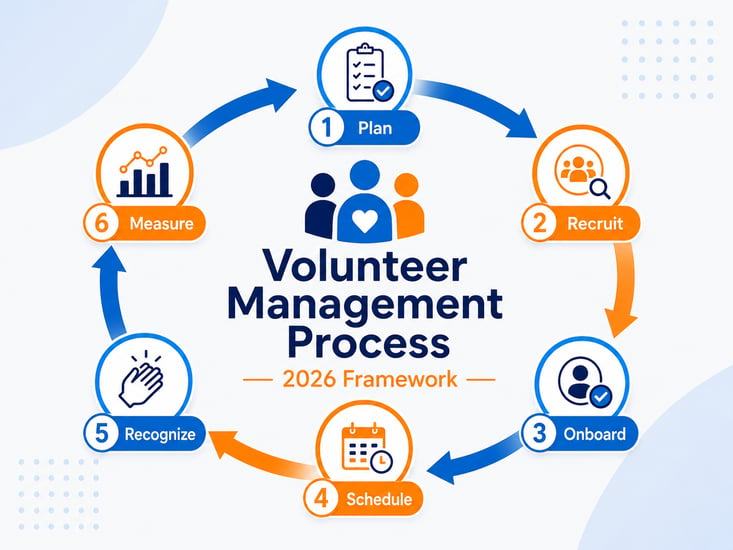
The volunteer management process is a loop with six stages. Each one feeds the next, and weak spots early in the loop create headaches downstream.
- Planning your program and setting goals
- Recruiting and registering volunteers
- Onboarding, screening, and training
- Scheduling, communicating, and engaging
- Recognizing and retaining volunteers
- Measuring and reporting impact
Stage 1: Planning your volunteer program and setting goals
This is the stage most programs rush through, and the one they later wish they'd given more time to. Planning is where you define what the program is actually for and how you'll know whether it's working.
A solid Stage 1 produces four things: a written program mission tied to your organization's strategic plan, clear role descriptions with task lists and time commitments, target volunteer counts by role, and a set of SMART goals (specific, measurable, attainable, realistic, time-bound).
Don't stop at hours and headcount when you're setting goals. Retention rate, no-show rate, time to a new volunteer's first shift, and the dollar value of contributed hours (now $36.14 per hour, per the Independent Sector) all give you a much better picture of program health.
The most common pitfall here is setting ambitious recruitment goals without matching support capacity. If you can welcome and onboard 20 new volunteers well, recruiting 50 just means 30 of them quit before their second shift. Match the goal to the support you can actually deliver.
Stage 2: Recruiting and registering volunteers
Stage 2 turns interest into a confirmed sign-up. In 2026, that experience needs to be mobile-first, completed in one sitting, and finished in under two minutes — or most prospective volunteers simply will not complete it.
A few things make recruitment work well today:
- Mobile-first registration, not just a site that loads on a phone
- Opportunity-specific landing pages for different programs or locations, so the message a corporate volunteer sees is different from the message a one-time event volunteer sees
- Short registration forms that ask only what you need today — you can collect more during onboarding
- Clear time commitment and role expectations so prospects know what they're signing up for
- Virtual and in-person options where it makes sense, plus skills-based opportunities for volunteers who want to use their professional expertise
VolunteerHub supports this stage with landing pages you can build for different programs inside one site, configurable forms so you can use different registration paths for different audiences, and group organization tools that segment volunteers from the moment they sign up.
The mistake we see most often: building one long registration form that asks for every possible data point. Long forms kill conversion. Keep the first form short. There's plenty of time to learn more about your volunteers later.
Stage 3: Onboarding, screening, and training
Stage 3 turns a registered prospect into a prepared volunteer. Three things are happening in parallel: paperwork (waivers, photo consent, emergency contact), screening (background checks for roles that require them), and training (mission orientation plus role-specific instruction).
What this looks like when it's working:
- Electronic waivers stored against the right event
- Background screening that runs through a vendor integration, not a manual process
- Training delivered in the right format for the role — in-person for high-touch positions, self-paced for low-touch ones
- An approval step that blocks shift registration until the prerequisites are met
In VolunteerHub, you have advanced waivers for storing and assigning waivers to specific events, direct integrations with background screening providers like Sterling Volunteers and People Facts, and workflow automation that handles the approval communications without requiring a coordinator to chase paperwork manually.
The common pitfall at this stage is concentrating all onboarding into a single, lengthy pre-shift session. Volunteers learn and retain more when onboarding is intentionally layered across their first few shifts. Provide what they need to feel confident for the first shift on day one, then deepen training and context as they return.
Stage 4: Scheduling, communicating, and engaging
This stage is the engine room of your volunteer management process. Most of the day-to-day work happens here — matching volunteers to shifts, sending reminders, following up on no-shows, and keeping people engaged between opportunities. It is also the point in the process most likely to exhaust coordinators if it is not supported by clear workflows and the right tools.
The good news: this is the stage where the right tools save the most time. A few things that consistently work:
- Publish recurring shifts in one operation, not one shift at a time. If you run a Tuesday-morning shift for the next twelve weeks, you should be able to set it up once.
- Caps and waitlists for popular opportunities, so you're not turning people away manually
- Group registration for corporate teams, families, and other groups who want to sign up together
- Check-in options that match the venue — a kiosk for big events, a QR code for outdoor sites, a mobile app for traveling volunteers, a paper roster when you need a backup
- Automated email and SMS reminders, so coordinators aren't typing the same message every week
- Messages that branch by behavior — a first-time no-show gets a different follow-up than someone who's been at every shift for a year
VolunteerHub handles this stage through the multi-event editor for recurring shifts, check-in tools for kiosk, QR code, and mobile check-in, the mobile app for volunteers on the go, and a workflow engine that fires automated communications based on what each volunteer does.
The biggest source of recoverable coordinator time we see in any program is manual reminder-sending. If you do nothing else in Stage 4, automate your reminders.
Stage 5: Recognizing and retaining volunteers
Recognition is not a feel-good extra. It is the intentional work that turns first-time attendees into committed volunteers who return again and again. In 2026, effective recognition is structured and consistent — a thoughtful program, not simply a stack of handwritten thank-you notes (though those still matter when they are specific and genuine).
What good recognition looks like:
- A documented cadence — post-shift thank-yous, milestone recognition at defined hour thresholds, an annual or year-end event
- Points or gamification where it fits your program culture
- Specific attention to volunteers you don't see in person — virtual volunteers, skills-based contributors, and anyone working behind the scenes who never walks into your building
VolunteerHub's rewards and recognition features let you build a structured recognition program — assign point values to events, run leaderboards, and fire congratulatory messages automatically when a volunteer hits a milestone like their tenth shift or their hundredth hour. The workflow engine handles the trigger so you don't have to track it manually.
The most common pitfall at this stage is also one of the most costly: focusing recognition only on the volunteers you see at events. Volunteers contributing skilled work from home, supporting operations behind the scenes, or leading efforts at satellite sites are doing essential work and often receive far less visible appreciation. Programs that celebrate only what is in the room risk quietly losing some of their most dedicated and impactful contributors.
Stage 6: Measuring and reporting impact
The last stage closes the loop. The data you collected in Stages 2 through 5 becomes the impact story for your board, your funders, and your planning for next year.
What measurement and reporting should give you:
- Hours captured automatically at check-in and check-out, not entered by hand at the end of the month
- Hours tagged by program, opportunity, or funder so grant applications and impact reports come together quickly
- Configurable reports beyond the canned templates, for the questions your board actually asks
- Dollar-value calculations using the current $36.14 Independent Sector rate
- Retention reporting that separates new volunteers from returning ones
- A reporting cadence the board actually uses — usually monthly or quarterly
VolunteerHub offers standard reporting for the most common questions, plus a custom reports builder for anything off-pattern. Whichever way your volunteers check in — kiosk, mobile app, QR code, daily check-in code — the hours all flow into the same reports.
The most common reporting pitfall is creating dashboards and reports that the board does not actually use. Begin with the decisions your board needs to make, then design a small set of reports that answer those questions directly. Resist the urge to show every metric the platform can produce and focus instead on the information that will guide action.
Where programs get stuck
The same three gaps show up in nearly every volunteer program, regardless of size or sector.
Goals you cannot measure. You set the goal in Stage 1, but did not capture the right data in Stages 2 through 5 to track it. The path forward is to work backwards from each goal to the specific data point that supports it, then confirm that data is captured, consistently and accurately, at the appropriate stage.
One person knows how everything works. When the entire process lives in your coordinator’s head, the program is operationally fragile. Vacations, illness, or a job change can slow or pause the work. Document the workflow for each stage, configure the automation that those workflows assume, and ensure at least one backup administrator is prepared to step in.
Recognition that does not connect to retention. You are investing in thank-you events, milestones, and gifts, but you do not yet know whether those efforts are keeping volunteers engaged over time. Establish a clear retention baseline (for example, the percentage of new volunteers who complete a second shift or a fifth shift), then monitor whether your recognition program meaningfully moves that number.
How VolunteerHub supports the volunteer management process
VolunteerHub has been helping nonprofits manage their volunteer programs since 1996. We're built for mid-size and large nonprofits, and the platform supports every stage of the process above:
- Recruitment and registration: landing pages and configurable forms
- Onboarding and screening: advanced waivers, plus direct integrations with Sterling Volunteers and People Facts
- Scheduling and check-in: multi-event editor, kiosk, mobile app, QR codes, and a daily check-in code
- Communication: workflow-based automation, system emails, and SMS (with opt-in)
- Recognition: rewards and recognition features, plus automated milestone messages
- Reporting: standard reports and a custom reports builder
We also integrate directly with Blackbaud's Raiser's Edge, eTapestry, Altru, and Salesforce — so the line between your volunteer data and your donor data doesn't get lost in spreadsheets and CSV exports. Pricing is based on active users (volunteers who registered for at least one event in the last twelve months), so retired or inactive records don't drive up your bill.
If you want to see how VolunteerHub maps to your specific program, connect with us, and we'll walk you through it.
Frequently asked questions
What are the six stages of the volunteer management process? The six stages are planning, recruitment, onboarding, scheduling, recognition, and measurement. Each one feeds the next, and the whole thing works as a loop you refine year over year.
What does a volunteer manager do? A volunteer manager — sometimes called a volunteer coordinator or director of volunteer services — runs the six-stage process described above. In larger programs, the work is split across a team. In smaller programs, one person does it all.
How do you create a volunteer management plan? Start with Stage 1. Write down your program's mission, define the roles, and set SMART goals. Then document the workflow for each remaining stage, pick the tools you'll use for each, and assign owners. Revisit the plan annually or any time the program changes shape.
What's the difference between volunteer management and volunteer coordination? Most people use the terms interchangeably. When organizations do separate them, "management" usually refers to the strategic and operational scope (program design, budget, technology, board reporting) and "coordination" refers to the day-to-day (scheduling, communication, check-in). The same six-stage process applies either way.
What's the best software for the volunteer management process? It depends on your program's size, the CRM your team uses, and your budget. For a buyer's framework, see Best Volunteer Management Software in 2026: How to Choose. For a side-by-side comparison of the leading platforms, see 10 Best Volunteer Management Solutions for Nonprofits in 2026.
How do you measure whether a volunteer program is working? Measure against the goals you set in Stage 1. The basics are total volunteer hours (multiplied by the $36.14 Independent Sector rate for dollar value), unique active volunteers, retention rate by cohort, no-show rate, and time to a new volunteer's first shift. Layer program-specific outcome metrics on top of those.
How does the process work for virtual or hybrid programs? The six stages stay the same. The specifics shift. Recruitment leans on digital channels and asks about technology readiness. Onboarding includes a tech orientation. Scheduling and engagement rely on automated communication and digital check-in instead of a physical kiosk. Recognition has to reach people who never walk into your building. If your program runs both virtual and in-person, it's worth documenting both versions of each workflow.